CaseStudy
- title
- summary
- role
- status
- stack
- sections
- may
- quote verbatim · summarize · link to sections
- may not
- invent metrics · speak for past employers · expose gated content
eHignite
A unified patient portal that pulls fragmented EHI exports from every provider into one place, and uses AI to translate clinical reports into plain language patients can read.
Summary
- problem
- approach
- status
- may
- quote verbatim
- may not
- round or extrapolate results
At a glance
- Problem
- EHI exports are split across providers and hard for patients to read, and bills arrive separately on paper. Patients end up piecing it all together themselves.
- Approach
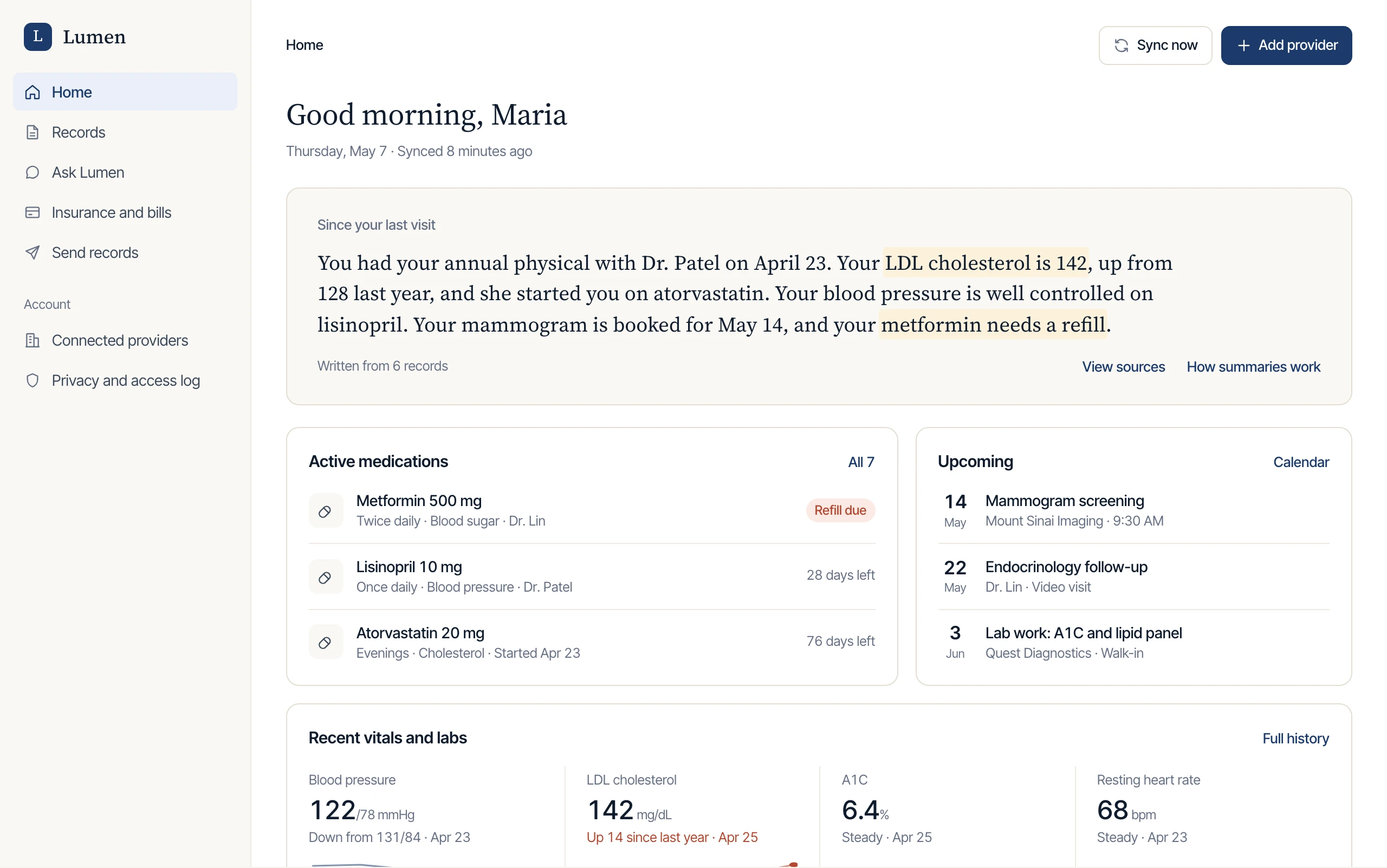
- A patient-owned portal that combines EHI exports from every provider. AI turns clinical reports into readable summaries and answers questions in a chat that cites its sources and gives no medical advice.
- Status
- Phase 1 brief and static wireframes submitted to the ONC eHignite Challenge.
Context
An entry in the ONC eHignite Challenge
Built for the ONC eHignite Challenge, which has prize money attached. Phase 1 was a strategic brief plus static wireframes.
I did Phase 1 alone, covering strategy, problem framing, product design, and the AI-orchestration architecture. The foundation is built on Next.js 16 and React 19.
Problem
Why EHI exports are hard for patients to use
Fragmentation
Every provider exports separately, so there's no single view of a patient's own history.
Illegibility
Reports are written for clinicians. Most patients can't parse the labs, codes, or shorthand.
Paper trail debt
Bills arrive late by mail from each provider, uncoordinated, untracked, and with no sign of which are urgent.
Under the 21st Century Cures Act, providers have to give patients their Electronic Health Information on request. In practice, that means a PDF dump from one provider, a different format from another, a third login at a third portal, and paper bills arriving in the mail.
These three problems compound each other. Patients are left to pull it all together themselves, and most can't.
Solution
A single portal for every provider's records
AI export reader
Configured for each export format. Returns factual, plain-language summaries without giving advice.
Appointment tracking
Pulls next-step suggestions from the last visit notes and surfaces them when they're relevant.
Sourced AI chat
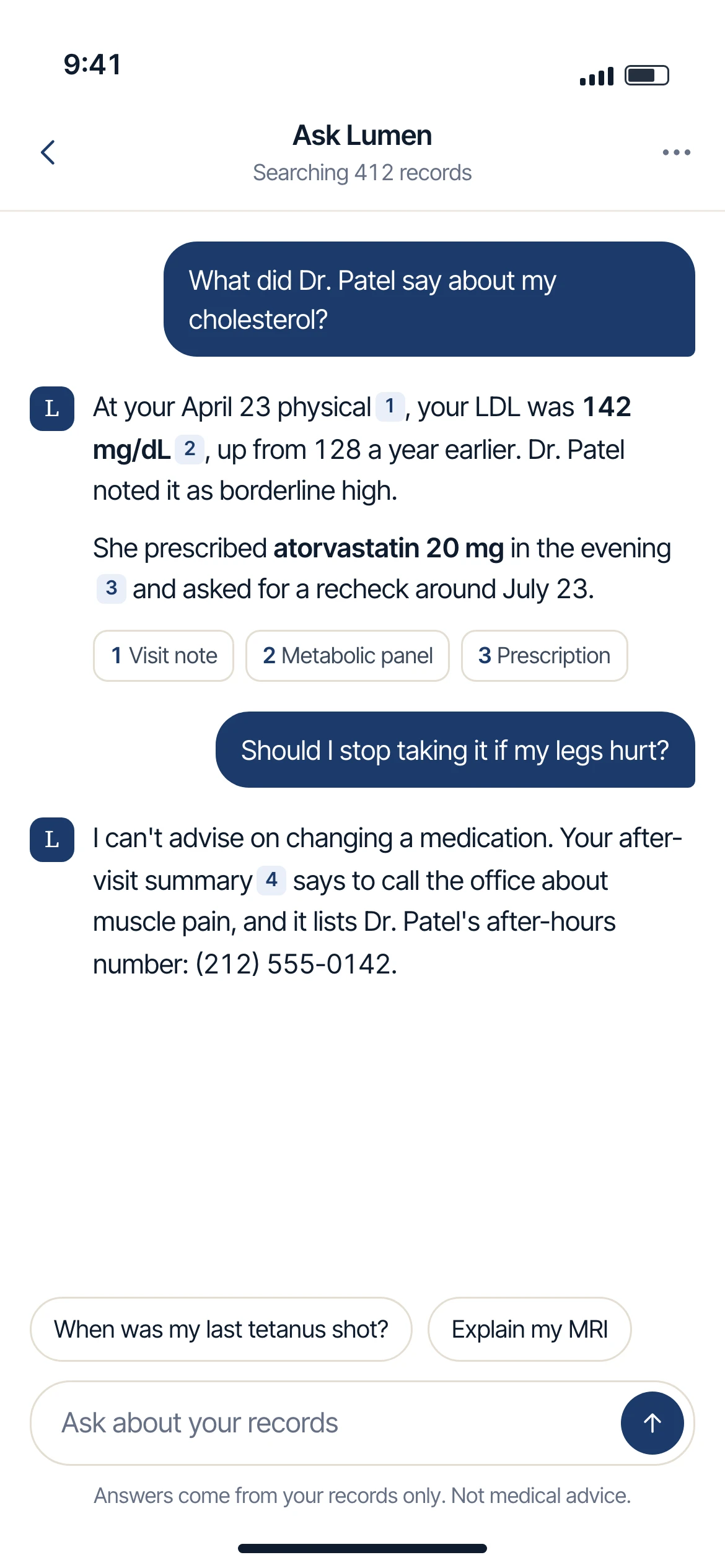
Reads back the actual line from the export. Every answer cites its source, with no medical advice.
Live dashboard
Vitals from the most recent visit, medications to pick up, prescriptions expiring soon, and bills, all in one place.
One-click portability
Sends the unified record to a new provider without re-pulling from every old one.
The portal is patient-owned. In the chat, a patient can ask “what did Dr. K say about my blood pressure last visit?” and the system reads back the actual line from the export.
How it works
How patients move through the product
Onboarding is the only step that asks much of the patient. They sign in once at each provider's own portal, so Lumen never sees a password. After that, records sync in the background.
Every record goes through the same normalization step, so the home summary, the chat, and the sharing flow all read from one record. Two checkpoints guard the flow. Consent can be revoked from the access log at any time, and every chat question passes a scope check that declines requests for medical advice.
Screens
The product, screen by screen
Connect your providers
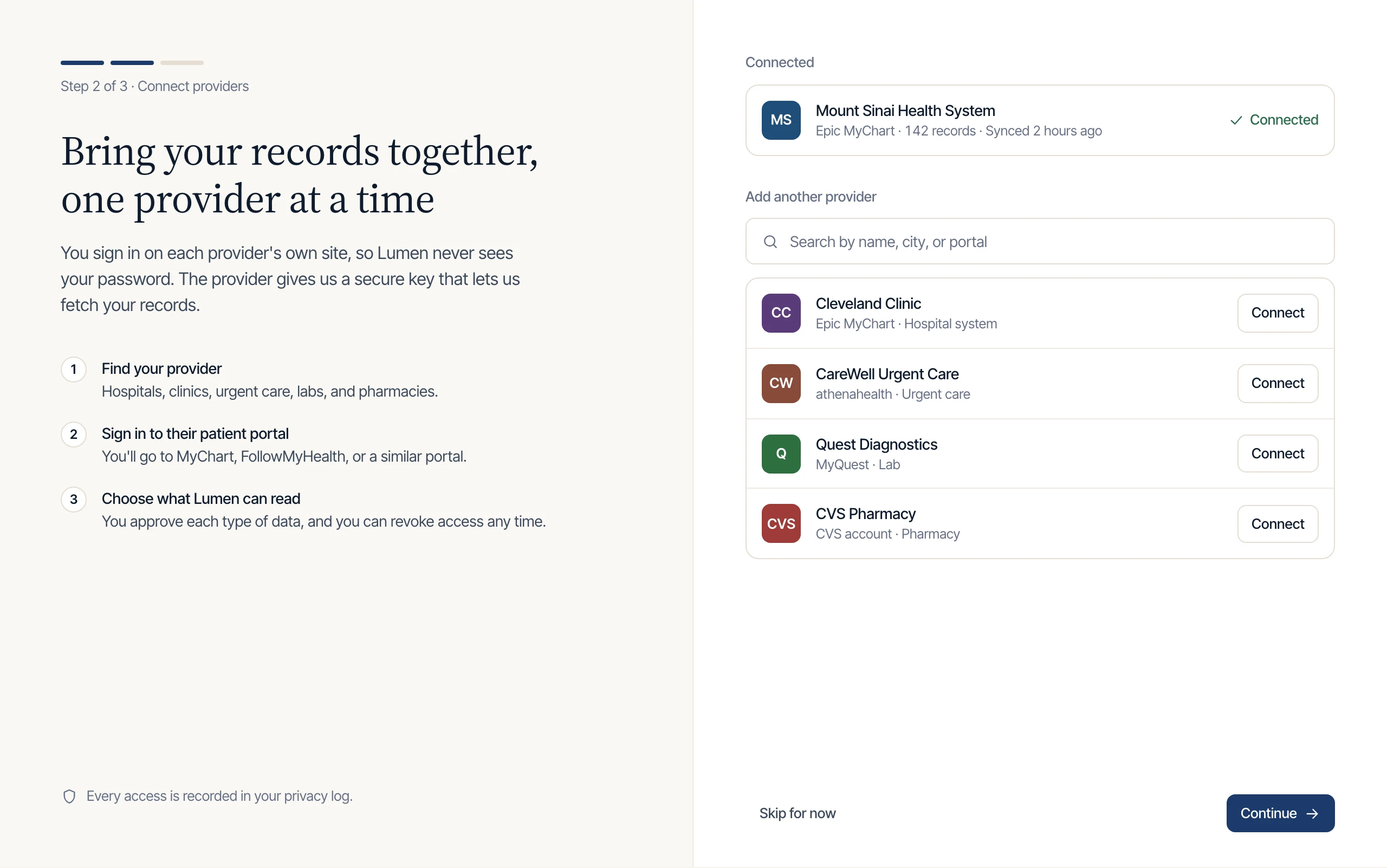
Patients sign in at each provider's own portal, so Lumen never sees a password.
Home
A plain-language summary leads, with the refill and the high LDL highlighted.
Records
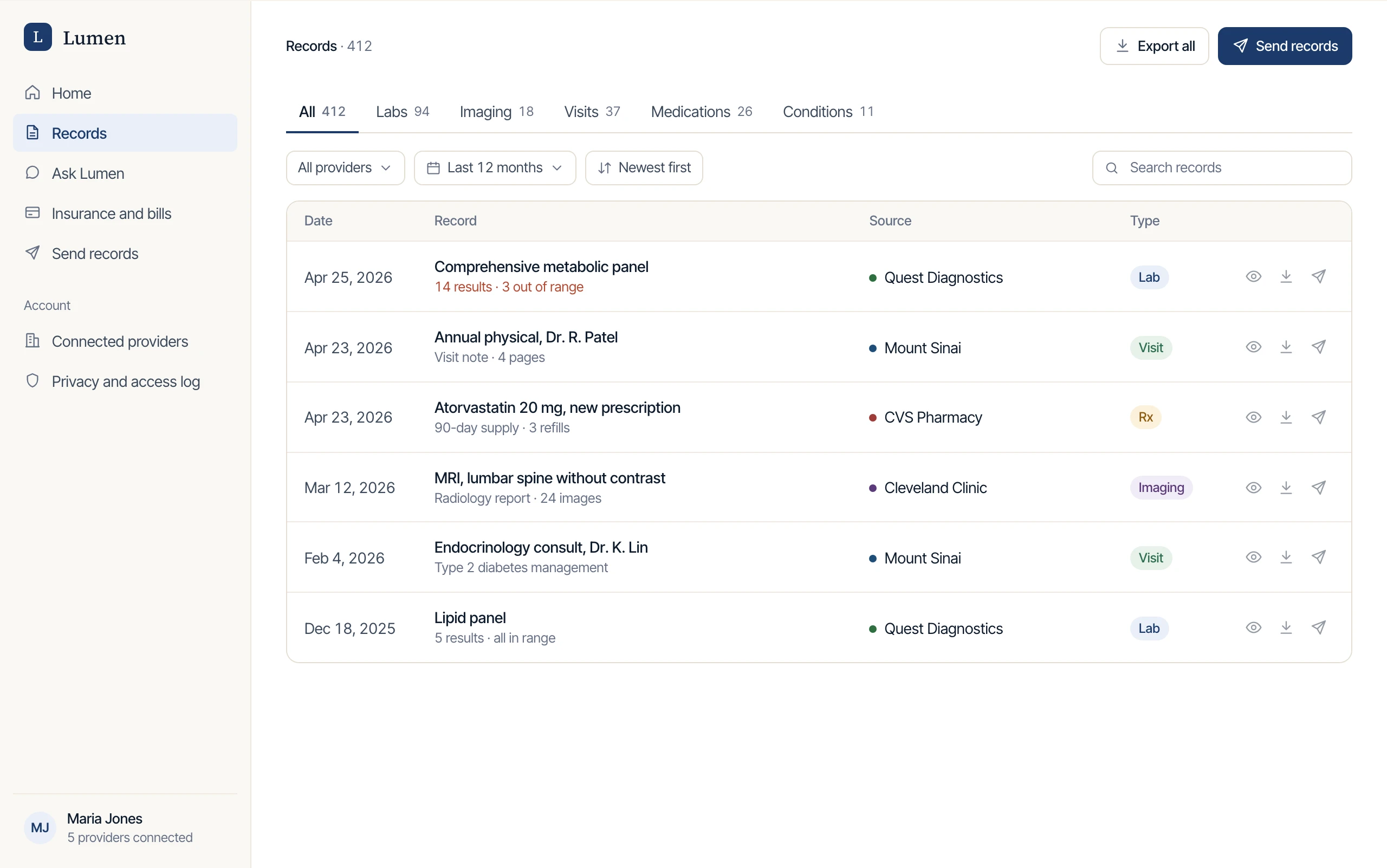
Every provider's records in one filterable timeline.
Ask Lumen
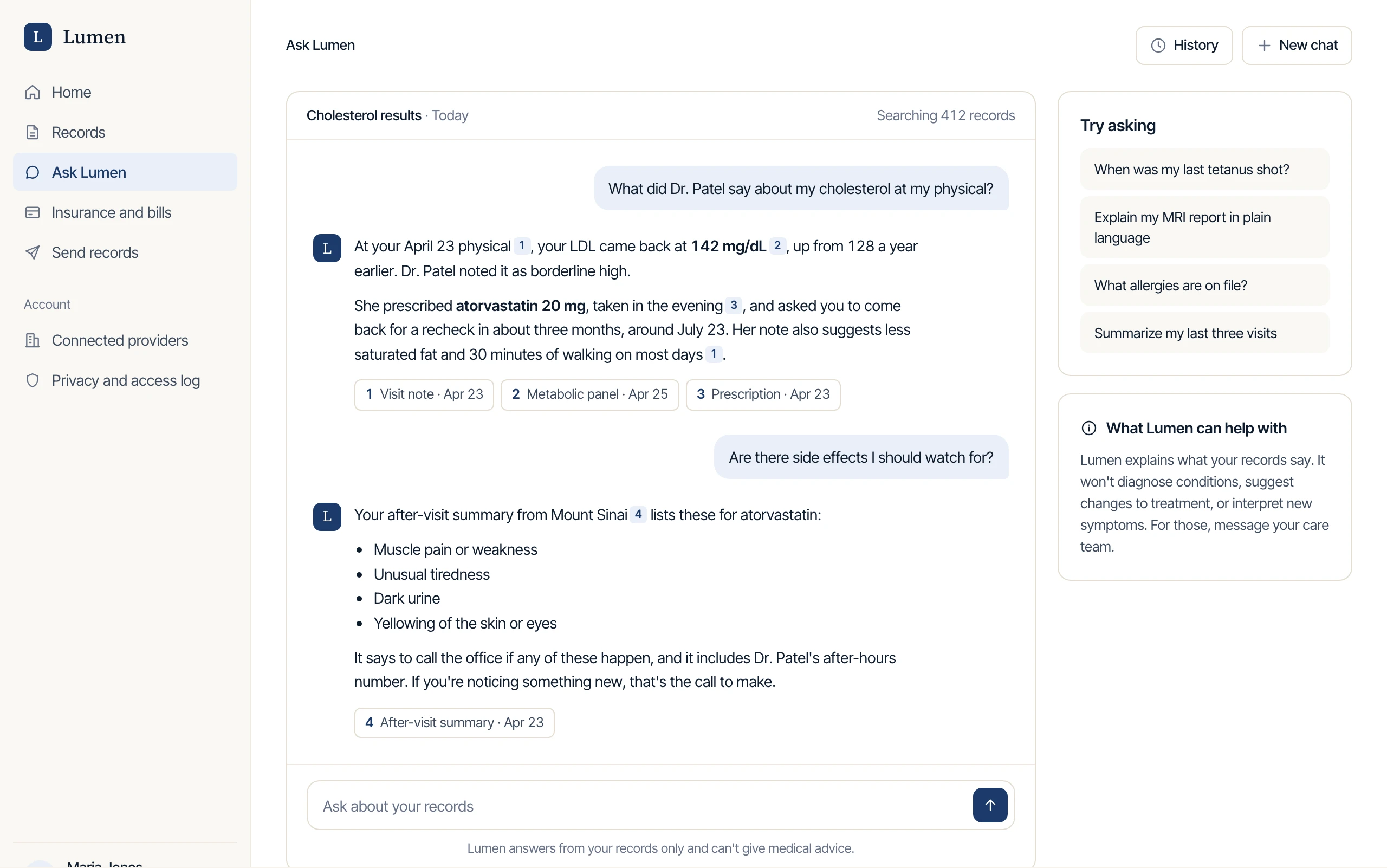
Every answer lists the records it came from.
Insurance and bills
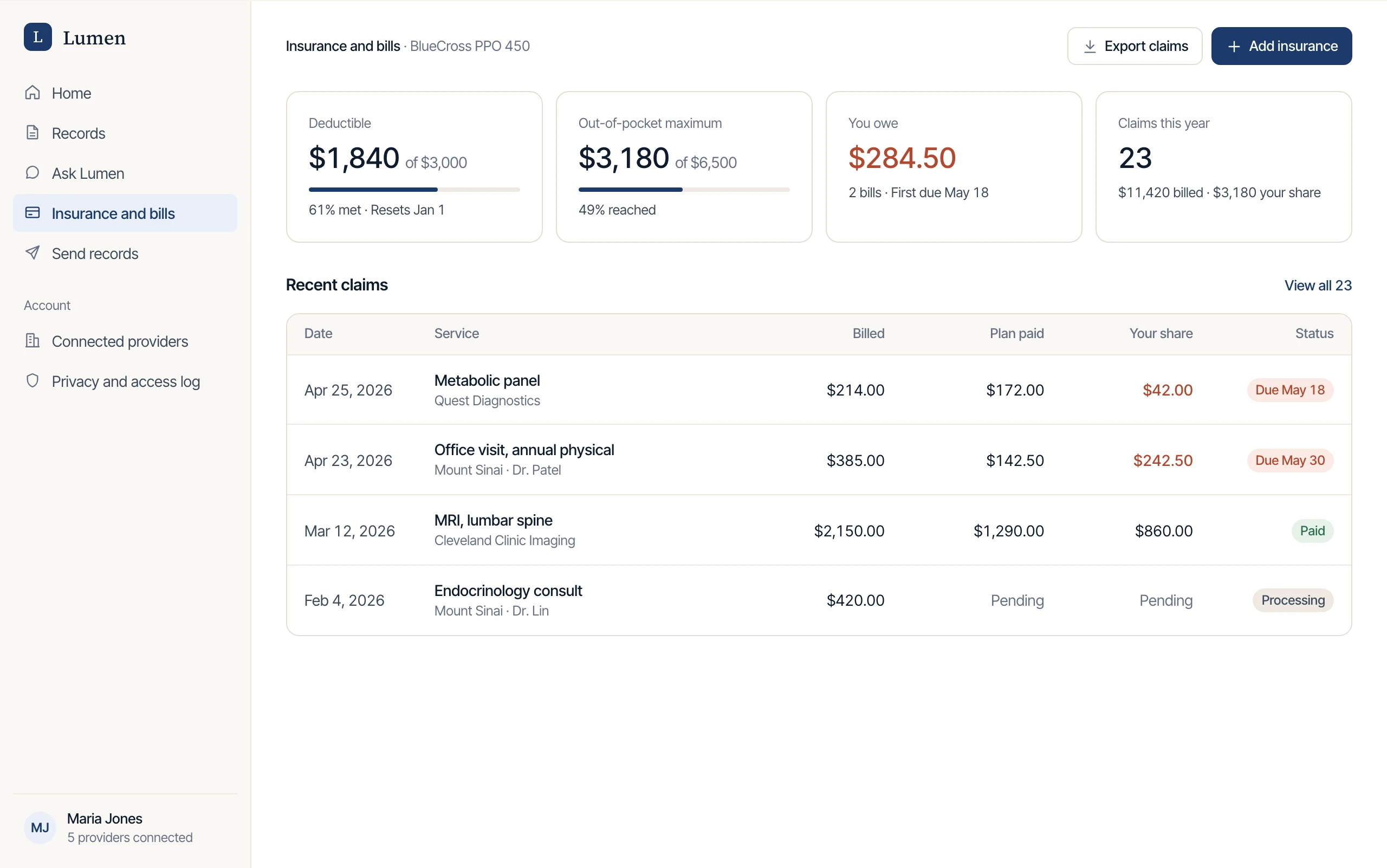
Claims from the CMS Patient Access API, next to the visits they belong to.
Send to a provider
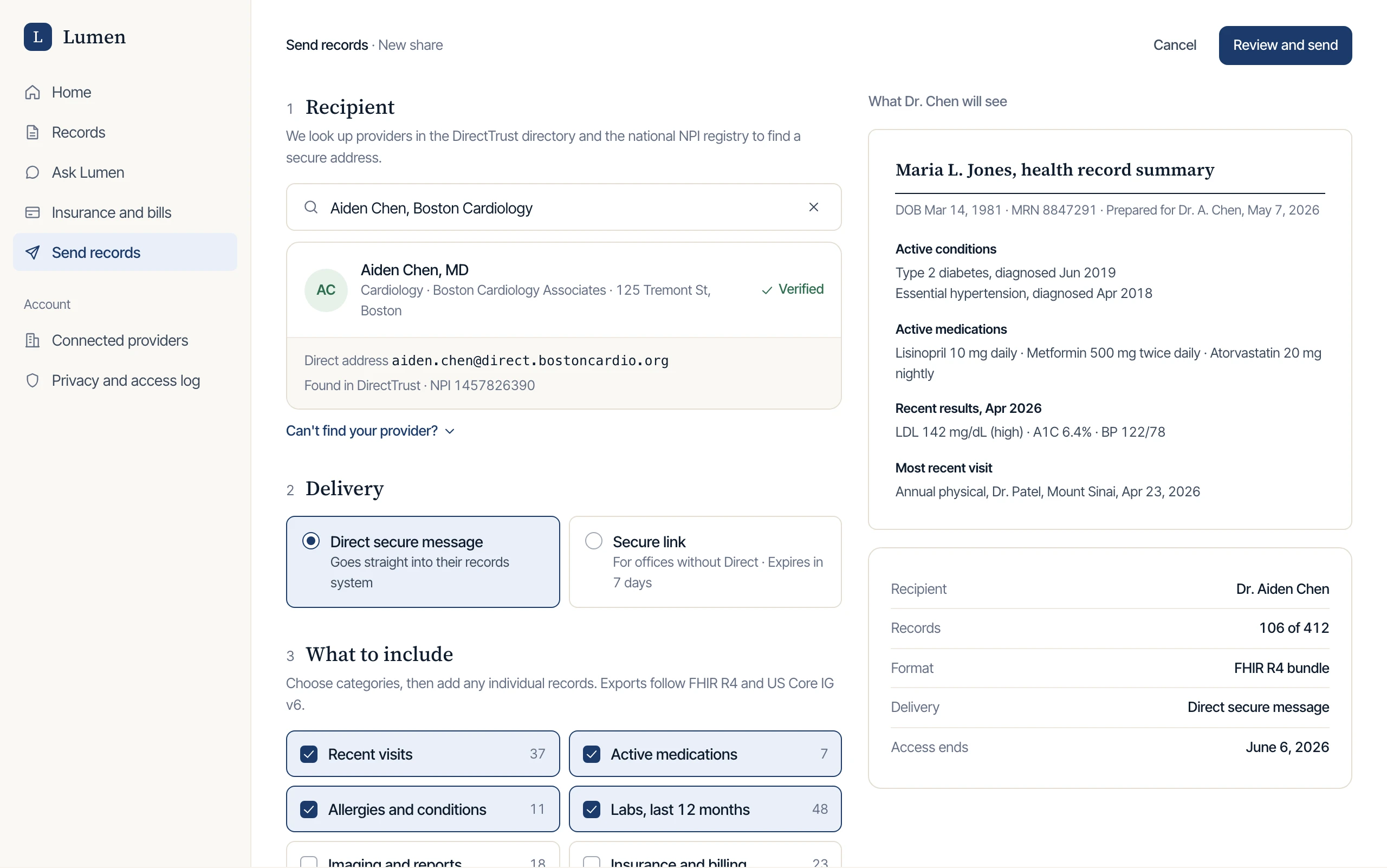
A live preview shows exactly what the receiving doctor will see.
On a phone
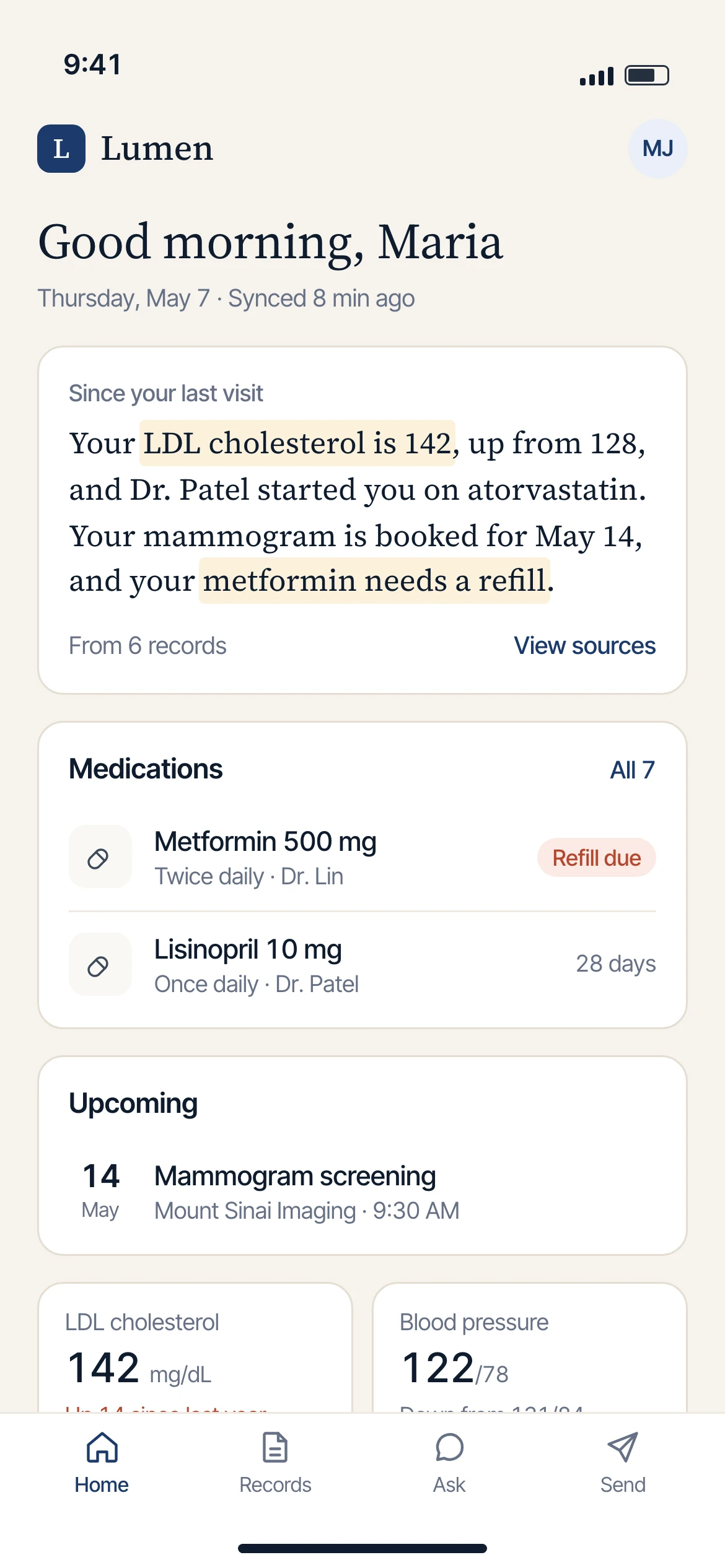
Home and Ask Lumen, the two views patients open most.
1 of 7 · Select a screen to enlarge it
These are refined versions of the Phase 1 wireframes. They follow one patient and one set of records throughout, so the numbers agree from one screen to the next.
Users
Patients who want to own their healthcare information.
Patients
Primary. Multiple specialists, chronic conditions to manage, recent care transitions, or a record in three or more places.
Control over their health information, and a way to understand it.
Providers
Secondary. Receiving information from a new patient.
A clean, structured handoff through the portability flow instead of faxes or scattered PDFs.
The primary users are patients who are tired of acting as the integration layer between their own providers.
The product takes a strict position on AI in healthcare. The AI translates, summarizes, and surfaces information, and cites where it came from. It does not diagnose, prescribe, or advise. Users can only trust the product if that line stays clear.
AI orchestration
How the AI layer is structured.
Each export format
- Its own schema
- Its own clinical shorthand
- Its own document structure
Mapped into
One normalized record
Read from one shape
- Chat
- Summaries
- Dashboard
Every answer cites its source. Every chat answer points to the exact line of the export it came from, and the user can click through to the original. I held the PK/PD engine to the same rule: every claim has to trace back to a source the user can inspect. In a clinical setting, that's what separates “the model said” from “your doctor said.”
Hard boundaries on advice. The AI can read back what a doctor wrote. It cannot interpret what the doctor meant, suggest a different course, or answer “should I…” questions. Those questions get an explicit refusal that points the user back to their provider.
Still to prove. Phase 1 established the orchestration boundary in the design. Holding it in working code, with real export data and real chat patterns, is the next thing to show.
Attachments
Phase 1 brief
The Phase 1 brief covers strategy, problem framing, the technical architecture, the AI approach, and the Phase 2 roadmap.
Document
Phase 1 brief ↗
Strategy, problem framing, user research, architecture, and roadmap. 11 pages. Opens in a new tab.