CaseStudy
- title
- summary
- role
- status
- stack
- sections
- may
- quote verbatim · summarize · link to sections
- may not
- invent metrics · speak for past employers · expose gated content
Producer vs. Client Portal
Eight disconnected third-party systems consolidated into one enterprise insurance platform for agents and clients. It is white-labeled, operates across multiple jurisdictions, and covers $38B+ in assets under management.
Summary
- problem
- approach
- impact
- may
- quote verbatim
- may not
- round or extrapolate results
At a glance
- Problem
- 8+ disconnected third-party systems (Zendesk, BIG, state licensing, commissions). Agents spent most of their time switching between platforms and correlating client data across systems by hand.
- Approach
- One enterprise platform for agents and clients, with white-label theming, automated compliance workflows, and a single source of truth behind both interfaces.
- Impact
- Managed hundreds of thousands of policies and clients across multiple company brands. Secured a white-label partnership with a company outside the parent company.
The platform covers $38B+ in assets under management and manages hundreds of thousands of policies and clients, with two companies operating on the same platform.
Problem
Agents spent their day switching between systems.
8+ disconnected systems, including
- Zendesk
- BIG background checks
- State licensing portals
- Commission systems
- Document repositories
- Communication tools
Consolidated into
A single source of truth
Serving
- Internal agents
- External agents
- Clients
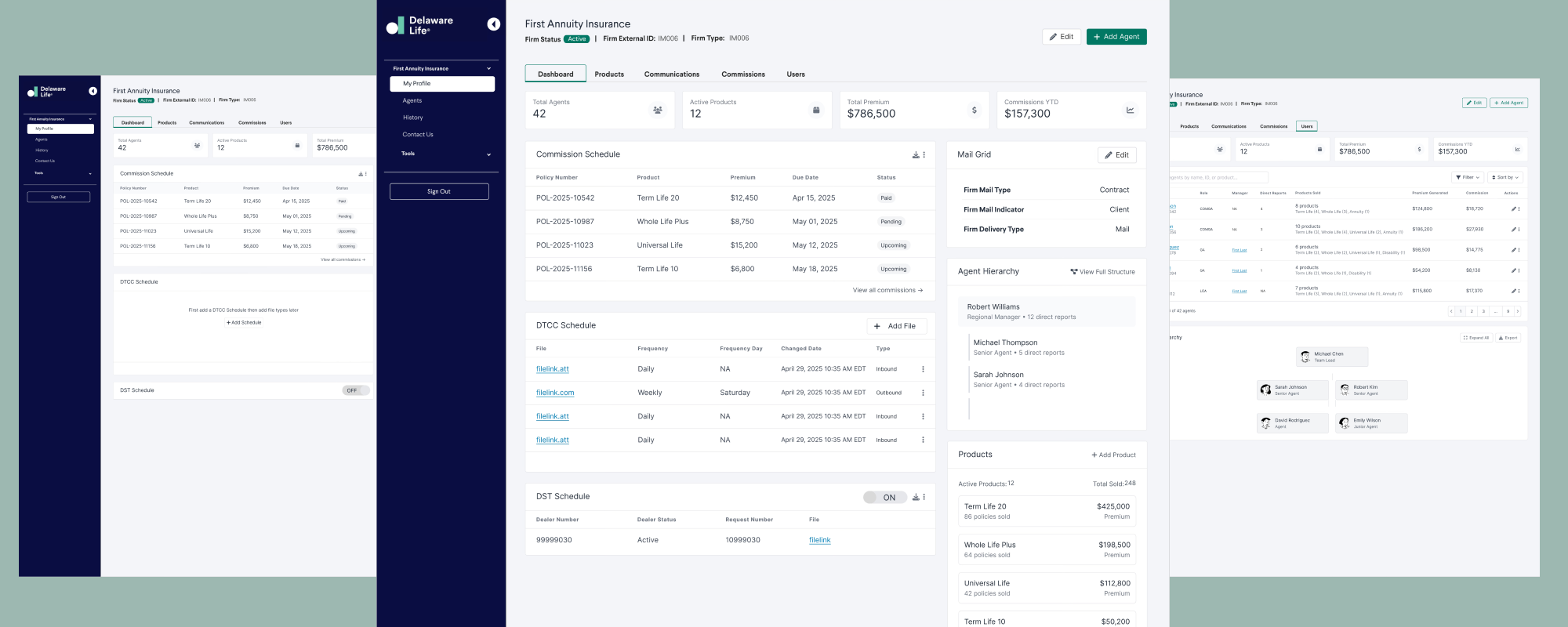
The enterprise insurance division operated through 8+ disconnected third-party platforms. Agents toggled between them constantly, and the fragmentation slowed operations as well as making the interfaces inconsistent.
- Significant agent time spent switching between systems instead of serving clients.
- Agents correlated client data across the eight systems by hand, and the delay added up with every customer interaction.
- Manual compliance tracking across state regulatory databases, with no audit trail spanning the systems.
Users
Internal agents, external agents, and clients.
Internal agents
Insurance professionals.
Managing agent networks, commissions, licensing, and client relationships.
External agents
Individual insurance agents.
Needing onboarding, licensing tracking, and policy management.
Clients
End customers.
Needing policy visibility, self-service capabilities, and clear communication.
The design problem was giving each audience something that felt like its own product while all three worked from a single source of truth.
Process
40-week first phase with an 18-engineer team.
40 weeks
Team: 1 product manager, 2 designers, 8 engineers, data architect, compliance specialist.
- research stakeholder interviews; workflow mapping across six systems; compliance requirement analysis.
- information architecture dual-CMS design; full wireframes; hierarchical structure for multi-level organizations.
- visual design enterprise design system; component libraries; white-label customization framework.
- user testing interactive prototypes; multi-stakeholder usability testing; regulatory expert validation.
- implementation third-party system integration; API orchestration; real-time data sync; white-label deployment.
Solution
Unified data, role-based surfaces, white-label theming.
Unified data architecture
A single source of truth serving agent and client interfaces, with access controls and real-time sync.
Progressive disclosure
Basic functions for new users, advanced analytics for experienced agents. Same interface, different density.
White-label architecture
Partners can customize the branding without forking the core platform.
Automated workflow integration
Compliance and onboarding embedded in the UI, replacing manual checks.
Role-based experience design
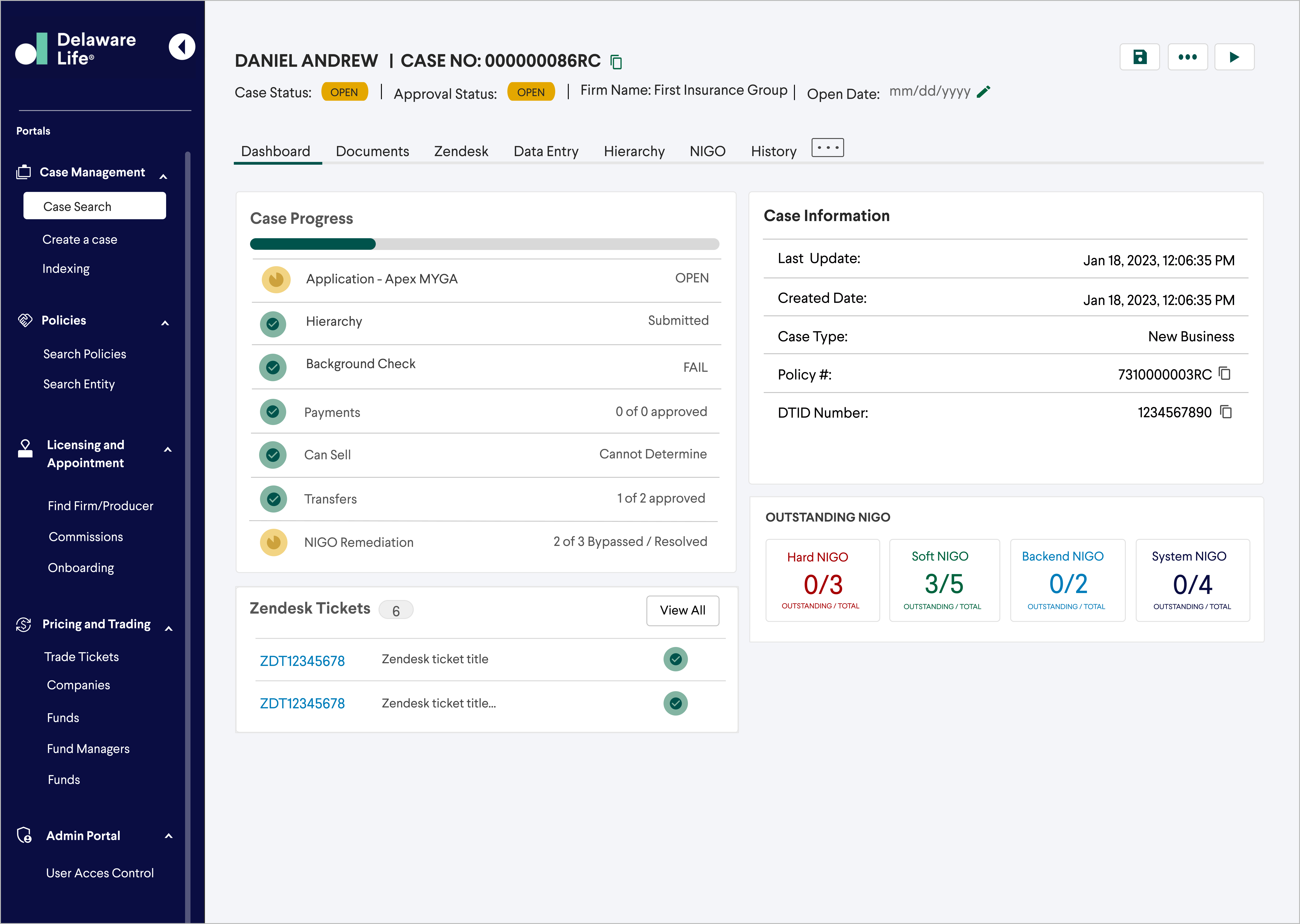
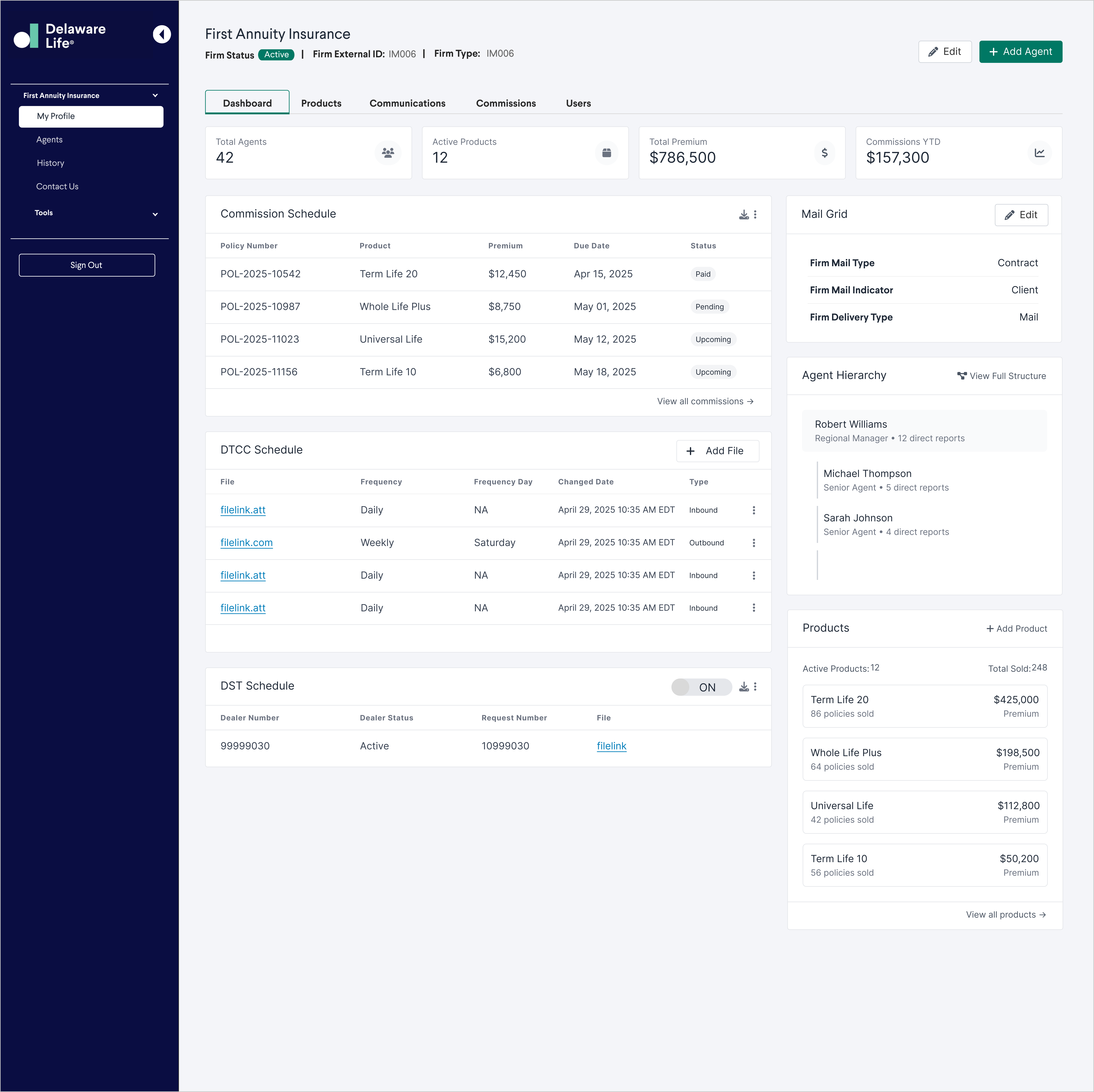
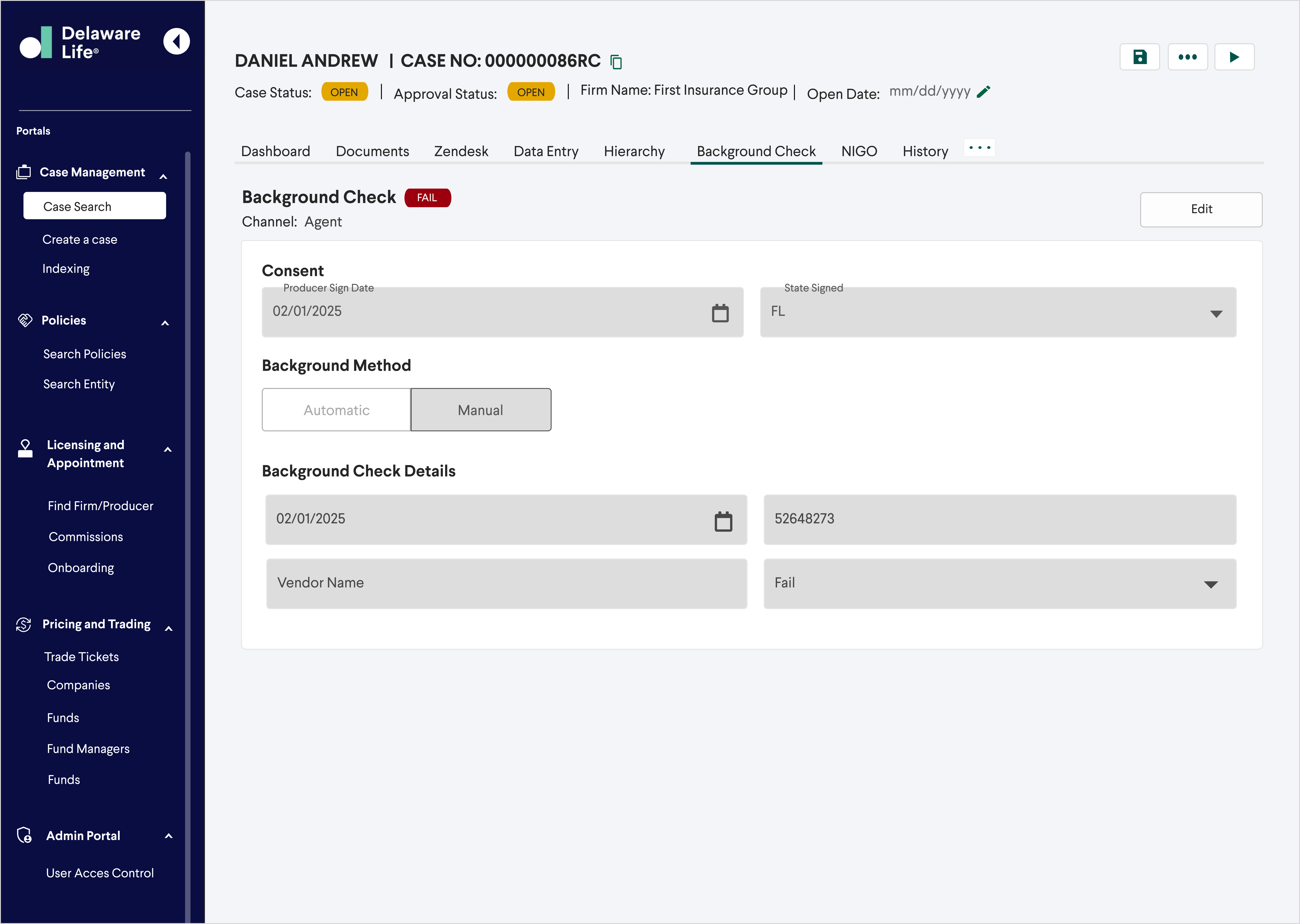
Separate, connected surfaces for agents, clients, and administrators, sharing data by permission.
Outcomes
Results in production.
Multiple company brands
Hundreds of thousands of policies and clients on a single underlying platform.
Multi-tenancy
Two companies operating on the same platform from day one of multi-tenancy.
White-label partnership
Secured with an outside company, which confirmed the architecture worked beyond the parent company.
Shipped features covering agent hierarchy, commissions, background checks, document management, and client portability.